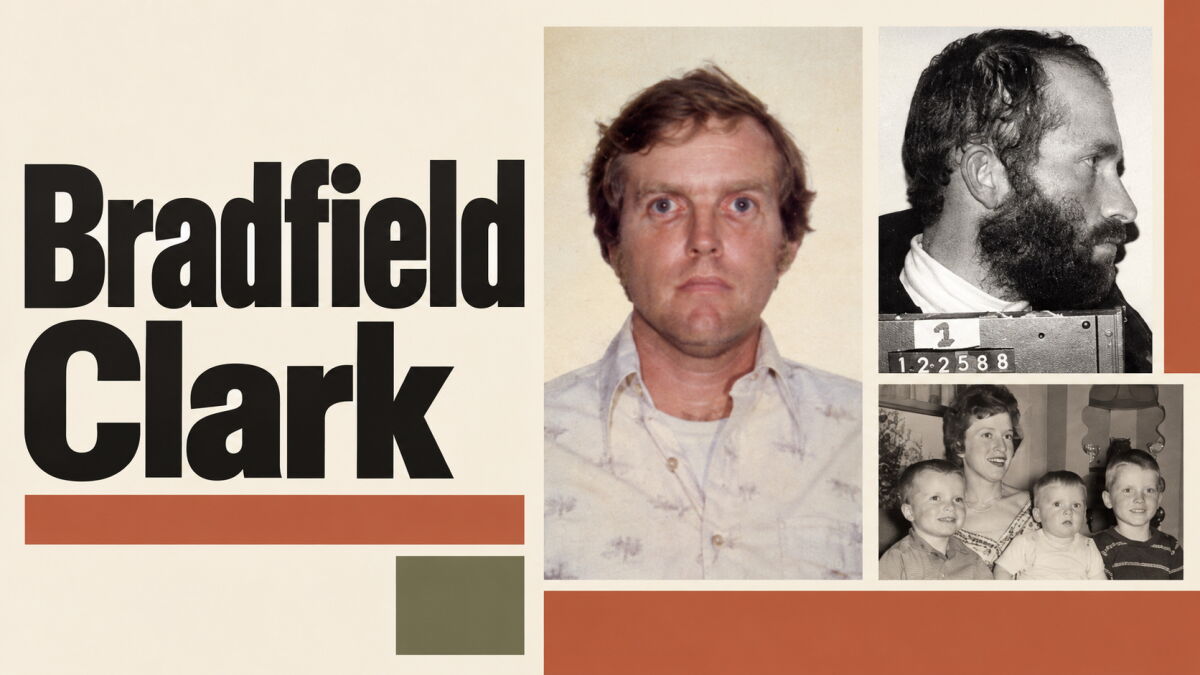
Basic Information
| Field | Details |
|---|---|
| Full Name | Bradfield Clark |
| Born | Early 1950s (reported) |
| Birthplace | Troy, New York (reported) |
| Occupation (pre-conviction) | Computer programmer |
| Notable For | 1984 murder of a co-worker in California; media accounts frequently describe dismemberment and alleged cannibalism |
| Conviction | Murder (1985) |
| Sentence | 25 years to life |
| Incarceration | California state prison system |
| Marital Status | Married prior to arrest; later estranged/divorced (reported) |
| Children | Reported to have children; identities not public |
| Notable Relatives | Hadden Irving Clark (younger brother; convicted serial killer) |
| Public Footprint | Minimal; largely referenced in context of his brother’s crimes |
Early Years and Family Fault Lines
Bradfield Clark’s story begins in the early 1950s in Troy, New York, the eldest child in a household frayed by alcoholism, volatility, and emotional distance. Accounts of the Clark home describe a father who battled alcohol and a mother perceived as detached, creating a climate of neglect and fear. Being the firstborn, Bradfield was often placed at the fulcrum of family tensions. Siblings followed—most notably Hadden Irving Clark—each shaped, in different ways, by the turbulence of their upbringing.
Several narratives tie the brothers’ later violence to those early years of instability. Yet causation is a slippery thread. While the family environment looms large, specialists caution against treating it as a single-key solution to a locked door. Many children endure hardship without committing crimes; many who commit crimes emerge from homes that look stable from the outside. In the Clark saga, nature and nurture were less two neat boxes than a tangled braid.
From Cubicles to Crisis
By his twenties and early thirties, Bradfield appeared to be tracing a conventional path. He left New York and pursued work in technology, reportedly as a computer programmer, and started a family. There are no reliable indicators of notable professional achievements or high-profile projects; his career seemed steady but unremarkable. Nothing in the public record suggested a public scandal or a looming rupture—until the summer of 1984.
The 1984 Murder and Aftermath
Bradfield killed a coworker in 1984 in California after a workplace argument escalated. A 25-years-to-life term followed his 1985 arrest and conviction. Modern and historical media accounts imply dismemberment and cannibalism. Though not all of the gory details are in court records, Bradfield was noted in headlines for them. The homicide, conviction, and life in prison are assured.
The victim has been identified by numerous accounts as Patricia Mak. The portrayal of the crime—and the sensational “cannibal” label—cemented Bradfield’s notoriety and overshadowed any prior sense of normalcy. A man who once coded for a living became a cautionary tale, invoked whenever the conversation turns to how hidden pressures can suddenly detonate.
Incarceration and Legal Status
Since his 1985 conviction, Bradfield has spent decades in the California state prison system. The 25-to-life term has meant repeated intersections with parole eligibility, institutional evaluations, and the slow metronome of prison years. There is little public evidence of jailhouse interviews, memoirs, or a cultivated media persona; his presence is a negative space, defined largely by silence and the occasional resurfacing of his case in true-crime programming.
The Brothers: Parallels and Divergences
Bradfield’s name now often appears in the shadow of his younger brother, Hadden Irving Clark, who was convicted in Maryland for the murders of Michele Dorr (1986) and Laura Houghteling (1992). Hadden is serving decades-long sentences and has been associated with additional confessions and claims over the years. When they are linked in articles and documentaries, the narrative tends to coalesce around the notion of “violent brothers,” a pairing as rare as it is morbidly captivating.
Yet the brothers’ paths diverged in telling ways. Bradfield’s violence erupted in a single, catastrophic homicide tied to a specific interpersonal conflict, at least as reported. Hadden’s violence spanned multiple victims and years. Both were shaped by the same family dynamics, but the trajectories were not identical. Their stories are more like parallel lines that occasionally bend toward each other rather than a neat overlay.
Media, Myths, and Mental Health
The Clark family has been filtered through decades of reporting, docuseries, podcasts, and viral threads. In that retelling, the line between “what happened” and “what’s been said to have happened” sometimes blurs. Sensational descriptors stick; more nuanced factors—mental health, head injuries, trauma histories—often fade from public memory.
When documentaries revisit the case, they often emphasize childhood abuse, alcoholism in the home, and escalating red flags. That narrative has value: it directs attention toward the profound effect of early adversity. But it risks monocausality. Complex behavior emerges from complex systems. Two truths can coexist: the Clark home was troubled, and not all of its children chose violence. Environment is a powerful wind, but not the only one.
Financials and Public Footprint
Bradfield’s long incarceration makes any discussion of net worth speculative at best. There is no reliable public record of assets, business ventures, or post-conviction income. Legal fees likely consumed resources; family members appear to have withdrawn from public view. Unlike his brother, who has generated periodic headlines, Bradfield seldom surfaces outside the orbit of true-crime retrospectives.
Family Overview
| Name | Relation | Notes |
|---|---|---|
| Hadden Clark Sr. | Father | Chemical engineer; widely described as alcoholic; associated with domestic instability. |
| Flavia Clark | Mother | Often described as emotionally distant; divorced from Hadden Sr. |
| Bradfield Clark | Eldest son | Convicted in 1985 for a 1984 murder in California; serving 25 years to life. |
| Hadden Irving Clark | Younger son | Convicted in Maryland for two murders; serving decades-long sentences. |
| Alison Clark | Daughter | Maintained a low public profile; mentioned in some family accounts. |
| Younger brother (reported) | Son | Scant public details; not implicated in crimes. |
Timeline of Key Events
| Year | Event |
|---|---|
| Early 1950s | Bradfield Clark is born in Troy, New York (reported). |
| 1960s–1970s | Childhood and adolescence marked by accounts of family turmoil and instability. |
| Late 1970s–Early 1980s | Moves into tech work as a computer programmer; marries; children reported. |
| 1984 | Murders a co-worker in California; media later allege dismemberment and cannibalism. |
| 1985 | Convicted of murder; sentenced to 25 years to life. |
| 1990s–2000s | Brother Hadden Irving Clark is convicted in Maryland for two murders; family’s notoriety intensifies. |
| 2010s–2020s | Case revisited in documentaries and true-crime media; Bradfield remains incarcerated. |
| 2024 | A docuseries again spotlights the family’s history and the brothers’ divergent but violent paths. |
The Human Factors: Risk, Resilience, Responsibility
Criminologists often map risk factors—childhood abuse, parental substance misuse, social isolation, early aggression—as if plotting coordinates of a storm. The Clark family presents many of those coordinates. But risk is not fate. Not every sibling veers off the same cliff. Some adapt and distance themselves; others fracture. That is what makes the Clark saga both cautionary and irreducibly complex. Responsibility for crimes remains with the individual, even as family, mental health, and chance loom in the background like weather systems.
How the Story Gets Told
Over time, the narrative around Bradfield hardened into archetype: the “cannibal brother,” a headline so lurid it nearly eclipses context. The label’s traction says as much about the media ecosystem as it does about the man. And yet, even stripped of sensationalism, the core remains brutal—one victim killed, a family shattered, and a life consigned to prison. The greater Clark story is a mirror tilted toward uncomfortable truths: violence sometimes runs in families; trauma can echo across generations; prevention requires seeing trouble before it peaks.
FAQ
Who is Bradfield Clark?
He is the older brother of Hadden Irving Clark and was convicted in 1985 for a 1984 murder in California.
What was his profession before the crime?
He reportedly worked as a computer programmer with no widely noted public achievements.
Was cannibalism part of the case?
Media reports frequently alleged it, though public legal records available today focus on the homicide and conviction.
What sentence did he receive?
He was sentenced to 25 years to life and has remained in the California state prison system.
How is he connected to Hadden Irving Clark?
They are brothers; both were raised in the same troubled household and both became convicted killers.
Did Bradfield have a spouse or children?
Reports indicate he married and had children prior to his arrest; their identities remain private.
Is he active on social media?
No; his name appears mostly in discussions about the broader family saga.
What explains the brothers’ violent behavior?
Analyses emphasize a mix of family dysfunction, mental health factors, and individual choices; no single cause suffices.
Where did Bradfield grow up?
He was born in Troy, New York, and later moved to California as an adult.
Has he given interviews from prison?
There is little public record of interviews; his presence in media tends to be archival or secondhand.